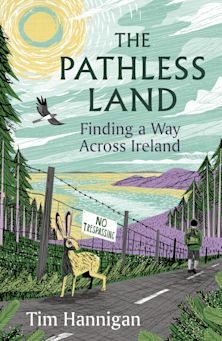
Tim Hannigan describes himself as “an author, academic and dedicated walker”. In his last book, The Granite Kingdom, he walked through his birthplace of Cornwall, exploring its landscapes and history, and how notions about this land in the far west have been shaped by writers, artists and others. For his next, which he summed up recently on social media as “another one of my sort-of-travel, sort-of-history, sort-of-something-else books”, he sets out to walk through the island he’s living on now, but doesn’t find it quite so easy. That’s because Ireland, as his title has it, is The Pathless Land (Head of Zeus, £25, August 27).
Footpaths, as he has said in a piece posted online (on the “knowledge exchange” platform Congregation), “are the oldest and most readily tangible form of human legacy – and thus one of our most compelling sources of metaphor (we talk of ‘trailblazers’ and of ‘pathways out of crisis’). The act of walking onto a piece of land for the first time creates an instant legacy: a 1:1 map of your own journey, and a simple but compelling form of infrastructure for the next person to – literally – follow in your footsteps.”
But following footsteps isn’t so easy in Ireland. There is is no right to roam on the mountains, as there is in Scandinavia and Scotland, and no network of public rights of way across the lowlands, as there is in France, Spain, England and Wales. Walking from Dunmore Head in Dingle to Burr Point on the Ards Peninsula, a journey of 416 miles (670 kilometres), Hannigan has to make his own way.
Old maps record a vast network of footpaths across the Irish landscape, and the Brehon Laws, which governed life in Ireland before the arrival of the Normans, ensured legal protections for walkers crossing the land of others. But without a modern legal framework for countryside access, over the past half-century this ancient legacy has been lost behind barbed wire and “no trespassing” signs. How, Hannigan asks, did this happen? And is there anything we can do to reclaim the legacy?
Leave a Reply