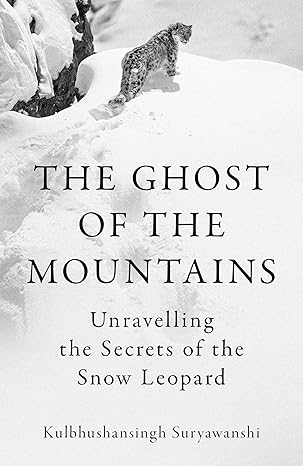
The Ghost of the Mountains (Granta, £20), in which the scientist and mountaineer Dr Kulbushansingh Suryawanshi takes us into the threatened world of the snow leopard, was reviewed at the weekend in the Financial Times, The Guardian and The Sunday Times.
In Peter Matthiessen’s haunting book The Snow Leopard (1978), says Nilanjana Roy in the FT, “the creature hovers like a spirit of redemption but is never seen, more symbol than living being. Suryawanshi makes these leopards real, in all their glory, subtle skill and extreme vulnerability in a book that reads like a classic of conservation — measured and thorough but imbued with a profound sense of discovery. Somewhere in the Gobi Desert, or in the Spiti Valley, snow leopards slip like phantoms through harsh landscapes, playful, magical — and, thanks to Suryawanshi, you too can follow in their pugmarks.”
In The Guardian, Edward Posnett (whose own books include Strange Harvests: Giving and Taking from the Natural World) says Suryawanshi’s book is “a gritty and detailed portrait of an often misunderstood and endangered species in an increasingly hostile, crowded and hot environment”. It can, he says, “almost be read in opposition to the quest narratives of, say, Peter Matthiessen or Sylvain Tesson. Much like a conservationist’s diary, his book is shorn of romance, and recounts the grind of observing and counting snow leopards in remote parts of the world, far away from his wife and young daughter.” The effect is “a gradual stripping away of mystification, revealing the snow leopard to be fragile and beautiful just like any other inhabitant of high mountain ranges… but no less wondrous for it, and no less deserving of our attention and respect.”
In The Sunday Times, James McConnachie says Suryawanshi’s account of his fieldwork is studded with “moving encounters” with snow leopards. “There’s plenty of conservation science, but it mostly reads like a travel book… [Suryawanshi] puts flesh back on the ghost. And teeth, and claws, and fur. It is not a replacement for Matthiessen’s The Snow Leopard — which will remain a literary classic — but as a scientific memoir it is a fine partner.”
The Guardian also had a review of Rory MacLean’s Geography of Heaven: Travels to the Hereafter (Abacus, £22). It is, says Kathryn Bromwich, “a moving, sometimes grandiloquent, grief-memoir-cum-travelogue”, in which MacLean “pairs an affinity for new-age thinking with a habit of loftily holding forth (“none of us are created for naught”, “love can but lead to truth”) and a proclivity for arresting one-liners (“I watched gods walk on fire”). In his search for meaning in the five years after his wife’s untimely death from cancer, he shows himself to be both refreshingly broad-minded and unnecessarily crotchety, like a more cantankerous Michael Palin.”
In The New Statesman, Chris Moss’s Where Tourists Seldom Tread: Postcards from Bypassed Britain (Guardian Faber, £20) was reviewed by the editor and writer Alex Niven (author of The North Will Rise Again). Moss’s “state-of-the-nation travelogue”, he says, “amounts to a handy, JB Priestley-esque survey of extra-metropolitan Britain at the dawn of the Burnham premiership. The neat part is that its author grew up in Burtonwood near St Helens, part of a north-of-Warrington sprawl that should probably now be renamed Burnham country.”
Leave a Reply